Dry Cupping vs Hijama | What’s the Difference? | East Toronto
Relief Plus Wellness Team · September 5, 2026 · 8 min read
Dry Cupping vs Hijama: What’s the Difference?
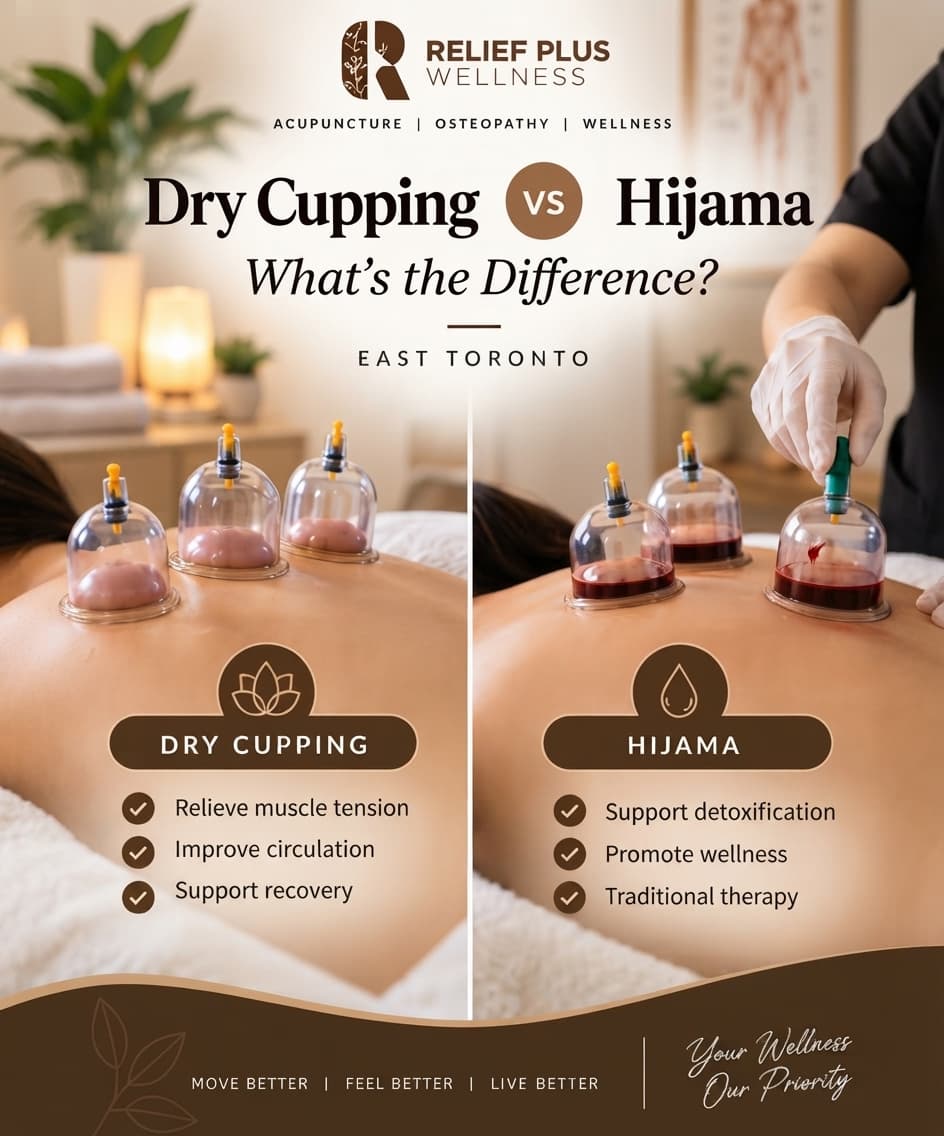
Dry cupping and Hijama both use cups to create suction on the skin, but there is an important difference between the procedures.
Dry Cupping
Dry cupping creates suction without intentionally opening the skin.
Cups may remain stationary or may be moved over appropriately lubricated skin.
Temporary circular marks and skin discoloration are common after dry cupping.
Hijama / Wet Cupping
Wet cupping involves suction together with small superficial skin openings so that a limited amount of blood is collected.
Because blood and broken skin are involved, Hijama requires additional infection-control precautions.
What Does Research Say?
NCCIH reports that most cupping research is low quality.
Cupping may help reduce pain for some people, but the evidence is not strong.
There is insufficient high-quality evidence to support many broader claims sometimes associated with cupping.
Which Has More Risk?
Both dry and wet cupping can cause skin effects.
Dry cupping may cause:
- Temporary marks
- Discoloration
- Burns when inappropriate heat technique is used
- Skin irritation
- Infection
Wet cupping adds risks related to:
- Bleeding
- Skin openings
- Blood exposure
- Scarring
- Infection
- Anemia when repeated frequently
Improperly processed blood-contaminated equipment can transmit blood-borne infections.
Do Either "Remove Toxins"?
Current high-quality evidence does not establish dry or wet cupping as a medical detoxification procedure.
The colour of cupping marks or collected blood should not be interpreted as evidence that toxins were removed.
Who Should Discuss Cupping Before Treatment?
People taking blood thinners, those with bleeding disorders, anemia, active infection, damaged skin, significant medical conditions, or pregnancy should discuss suitability with an appropriate healthcare professional before treatment.
Does Dry Cupping Involve Blood?
No. Dry cupping does not intentionally involve opening the skin or removing blood.
Does Hijama Involve Blood?
Yes. Hijama involves small superficial skin openings and collection of a limited amount of blood.
Which Treatment Is Better?
There is no universal answer. Suitability depends on the individual, health considerations, preferences, and treatment goals.
Do Cupping Marks Mean Toxins Were Removed?
No. The colour or appearance of cupping marks does not establish that toxins were removed from the body.
Dry Cupping vs Hijama in East Toronto
Relief Plus Wellness offers cupping services in East Toronto, including dry cupping and Hijama (wet cupping), for clients considering these traditional bodywork approaches.
Relief Plus Wellness
1403 Gerrard St E, Toronto, ON M4L 1Z5
Phone: (416) 461-1118
Open Daily: 10:00 AM – 7:00 PM
Frequently Asked Questions
Does dry cupping involve blood?
No. Dry cupping does not intentionally involve skin openings or blood removal.
Does Hijama involve blood?
Yes. Hijama involves small superficial skin openings and collection of a limited amount of blood.
Which treatment is better?
There is no universal answer. Suitability depends on the individual and their treatment goals.
Do cupping marks mean toxins were removed?
No. Current high-quality evidence does not establish cupping as a medical detoxification procedure, and the colour of the marks does not prove that toxins were removed.
Is Hijama safe for everyone?
No treatment is appropriate for everyone. People taking blood thinners, those with bleeding disorders, anemia, active infection, damaged skin, significant medical conditions, or pregnancy should discuss suitability before treatment.
Book Cupping Therapy in East Toronto
If you are considering dry cupping as a complementary wellness option, you can book Cupping Therapy with Relief Plus Wellness.
Relief Plus Wellness
1403 Gerrard St E, Toronto, ON M4L 1Z5
Phone: (416) 461-1118
Book Hijama (Wet Cupping) in East Toronto
If you are considering Hijama (wet cupping), you can book a Hijama service with Relief Plus Wellness.
Relief Plus Wellness
1403 Gerrard St E, Toronto, ON M4L 1Z5
Phone: (416) 461-1118
Open Daily: 10:00 AM – 7:00 PM
Disclaimer
This article is provided for general educational purposes only. Cupping is not a guaranteed treatment and does not replace appropriate medical care. Wet cupping involves skin openings and blood exposure and therefore requires appropriate infection-control precautions. Individual responses and risks vary.
Source
- NCCIH — Cupping.
Relief Plus Wellness proudly serves patients from Leslieville, The Beaches, East York, Riverdale, Danforth, Greenwood-Coxwell, Upper Beaches, Little India, Scarborough, Downtown Toronto, and surrounding East Toronto communities.